Location
Donetsk region, next to the settlement of Prymorske
Kind of cultural heritage
information is being clarifiedInvolved
representatives of illegal armed formations on the territory of the so-called Donetsk People’s Republic
Map
History
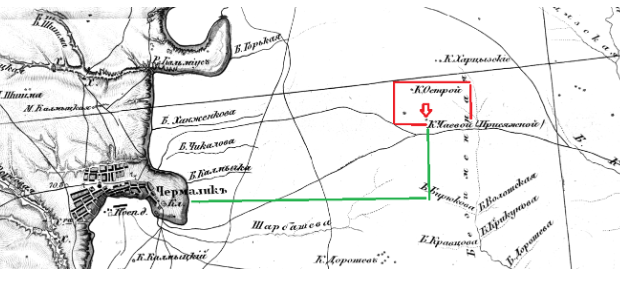
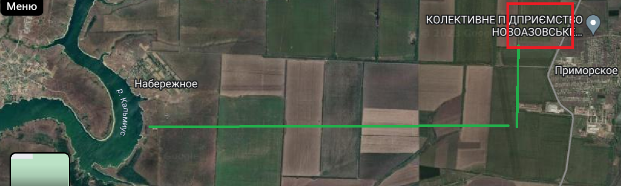
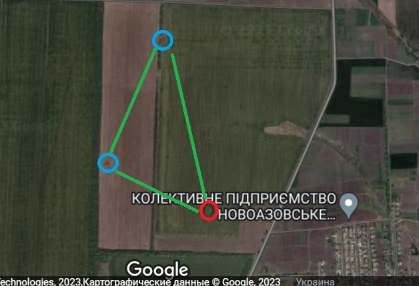
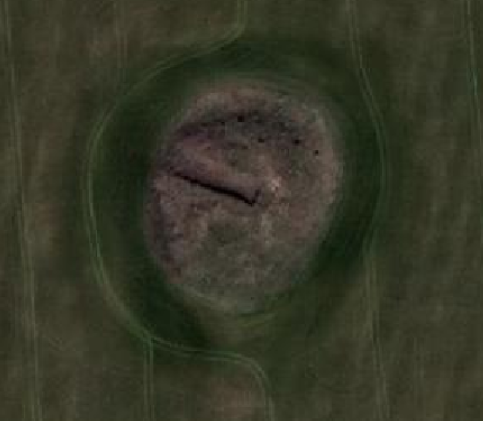
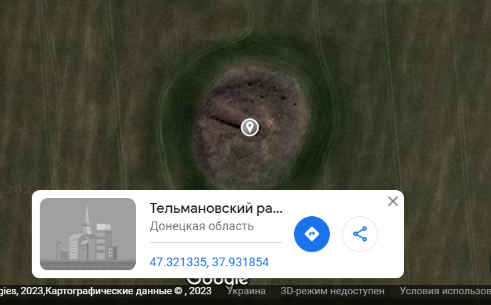
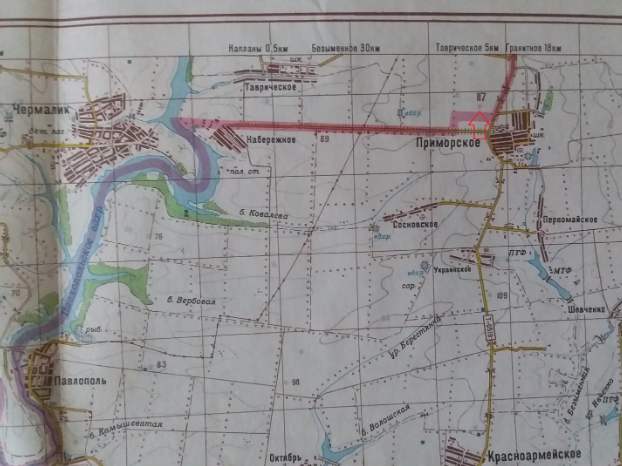
The site is located next to the settlement of Prymorske, 800 meters northwest from the development area. The verification of the locality of this monument raises certain difficulties that are inherent in determining the location of sites situated on wide watersheds of steppe gully systems. However, thanks to the presence of two more rather large barrows within the specified area, which have been preserved and form the corners of what can be called a triangle (picture No. 3) on the map of Theodor Friedrich von Schubert, we can confidently identify this damaged site as a barrow with the historical name Chaiovyi or Prysiazhnyi (“Juror”) (picture No. 1). In respect of this barrow, it should be noted that it is difficult to remotely determine the purpose for which the caponier was created (a fortification structure for flanking or enfilade fire in two opposite directions) measuring 5 x 25 meters, which crossed the mound of the barrow from the northwest, apparently, from the level of the adjacent field in the direction of the center (picture No. 4). Based on the orientation of the caponier and its size, it can be assumed that the purpose of its creation in 2015 was exclusively military, purely extortionate or both.
Violation description
According to information from media outlets, during the active construction of fortifications by representatives of illegal armed formations on the territory of the so-called Donetsk People’s Republic, several samples of archaeological stone plastic art forms were found, one of which was evacuated by former employees of the Donetsk Regional Museum of Local Lore (since 2015 – the so-called Republican Museum of Local Lore) to the city of Donetsk. This is a unique analogue of the famous Scythian statue from the village of Olkhovchyk and is the archetype of the Golden Scythian brand. Using the example of the destruction of the Chaiovyi Barrow, we can conclude under which circumstances the Russians appropriate archaeological sites in the occupied territories. The stone plastic art forms that were stolen by the occupiers in Donetsk region are unique and testify to the existence in the past of the practice of burying stone stelae in barrows.
Gallery
Article source and links
- Internet resource of the so-called DPR
- Archaeological Almanac, No. 30, 2013, Donetsk. "Donbas" pp. 47, 60.
- Archaeological Almanac, no. 30, 2013. Donetsk: Donbas.