General information
Location
Kind of cultural heritage
ArchaeologicalObject type
СonstructionsViolation type
information is clarifiedResearch zone
Zaporizhzhia regionMap
Object history and violation description
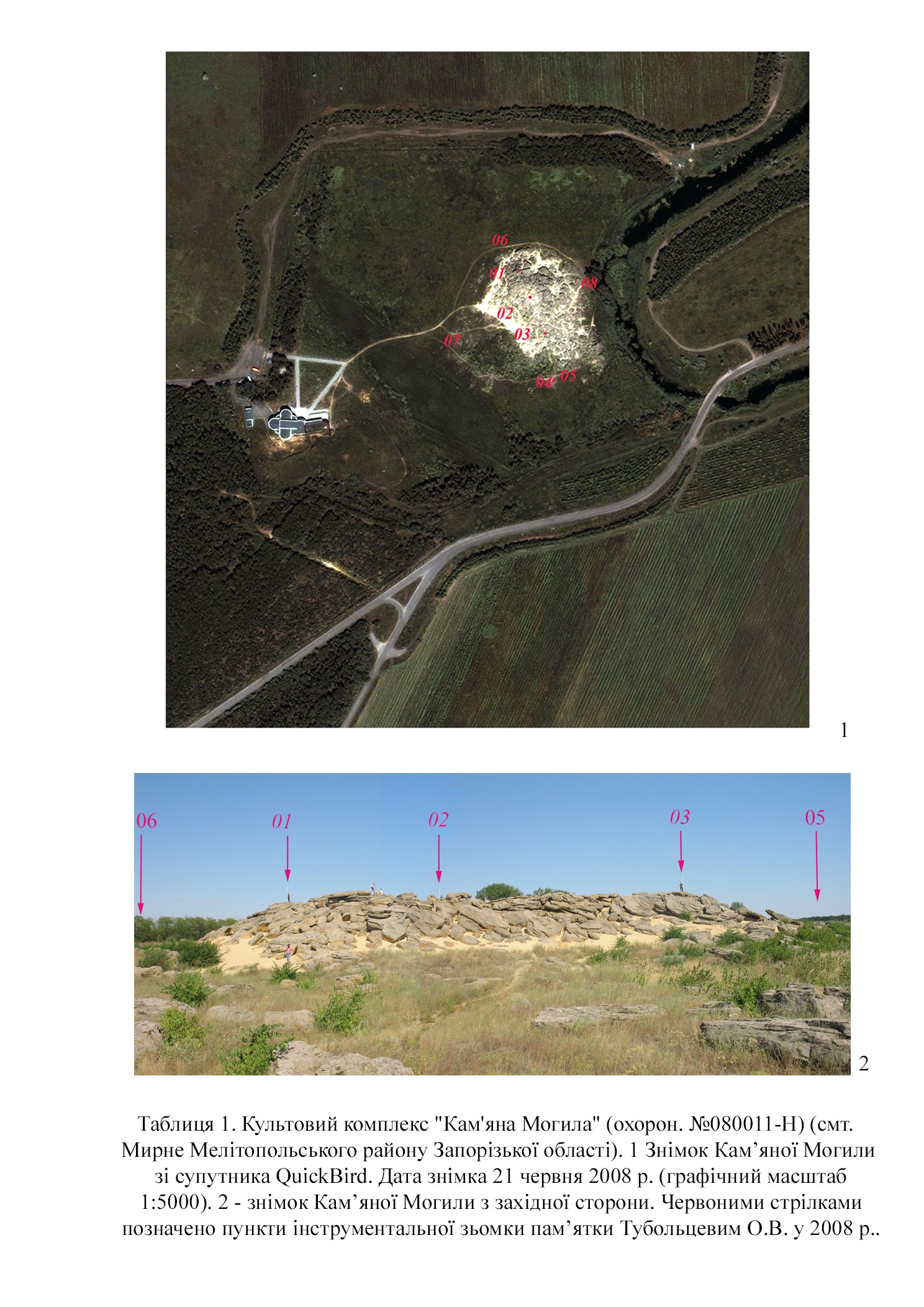
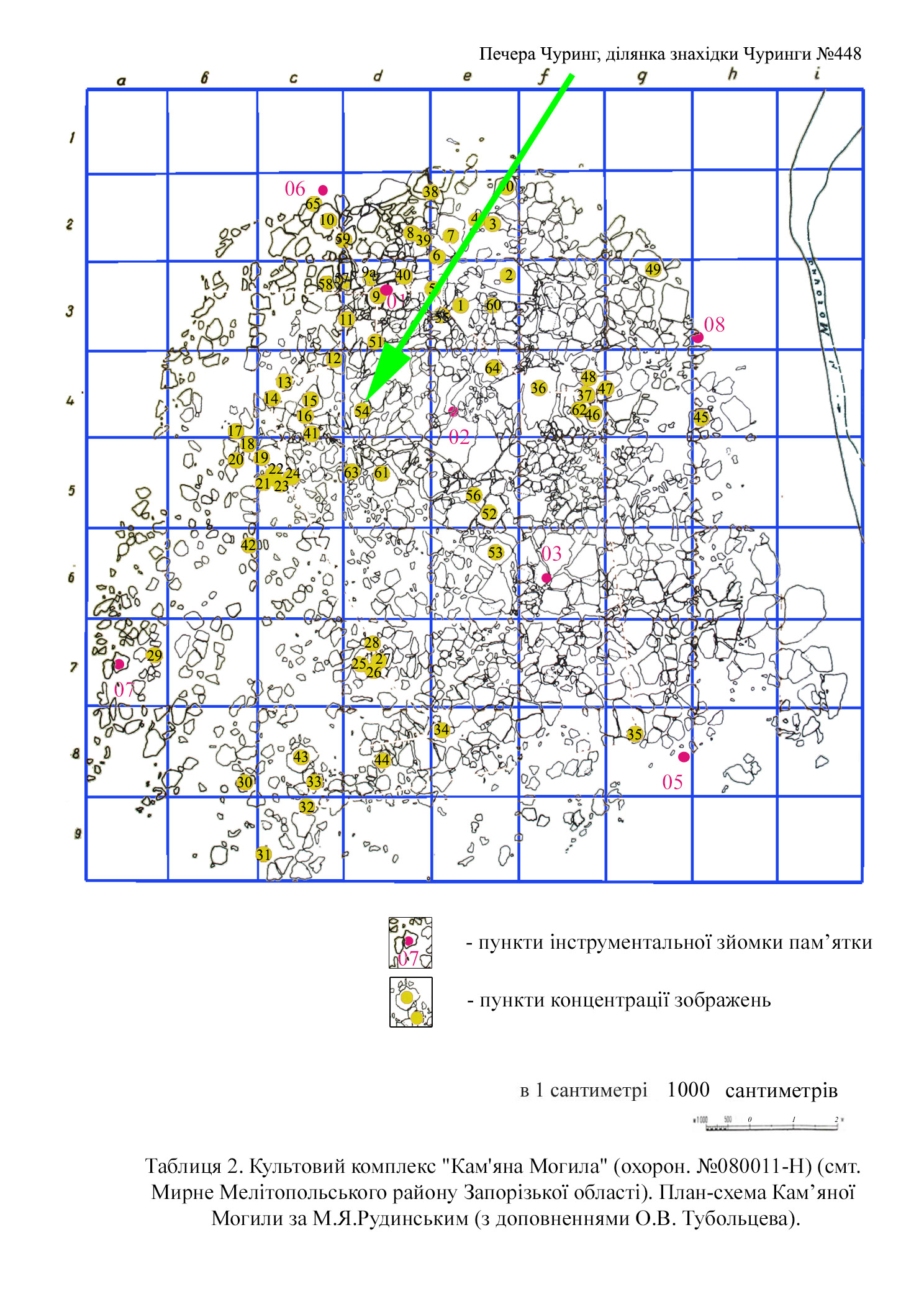
Kamiana Mohyla (“Stone Tomb”) is a unique archeological site and monument of the history of ancient art and religion. The central complex consists of an 11-meter shell-shaped sandstone hill, which preserves the entrances to the caves and grottoes. According to scientists, about 64 locations with images from different eras were found here (Tables 1, 2). In the 1960s, Kamiana Mohyla was granted the status of a monument of local significance (Resolution of the Council of Ministers of the Ukrainian SSR No. 711 "On approval of the list of monuments of art, history and archeology of the Ukrainian SSR") (protection No. 33). The Kamiana Mohyla Historical and Archaeological Preserve is designated as the user. The main scientific theme of the museum exposition is the reflection of the stages of the history of the development of art. The first fund collection was formed by the staff of the Institute of Science of the National Academy of Sciences of Ukraine, among whom it is worthwhile to mention such famous scientists as O. Bader, M. Ya. Rudynskyi, V. Hladilin and V. Danylenko.
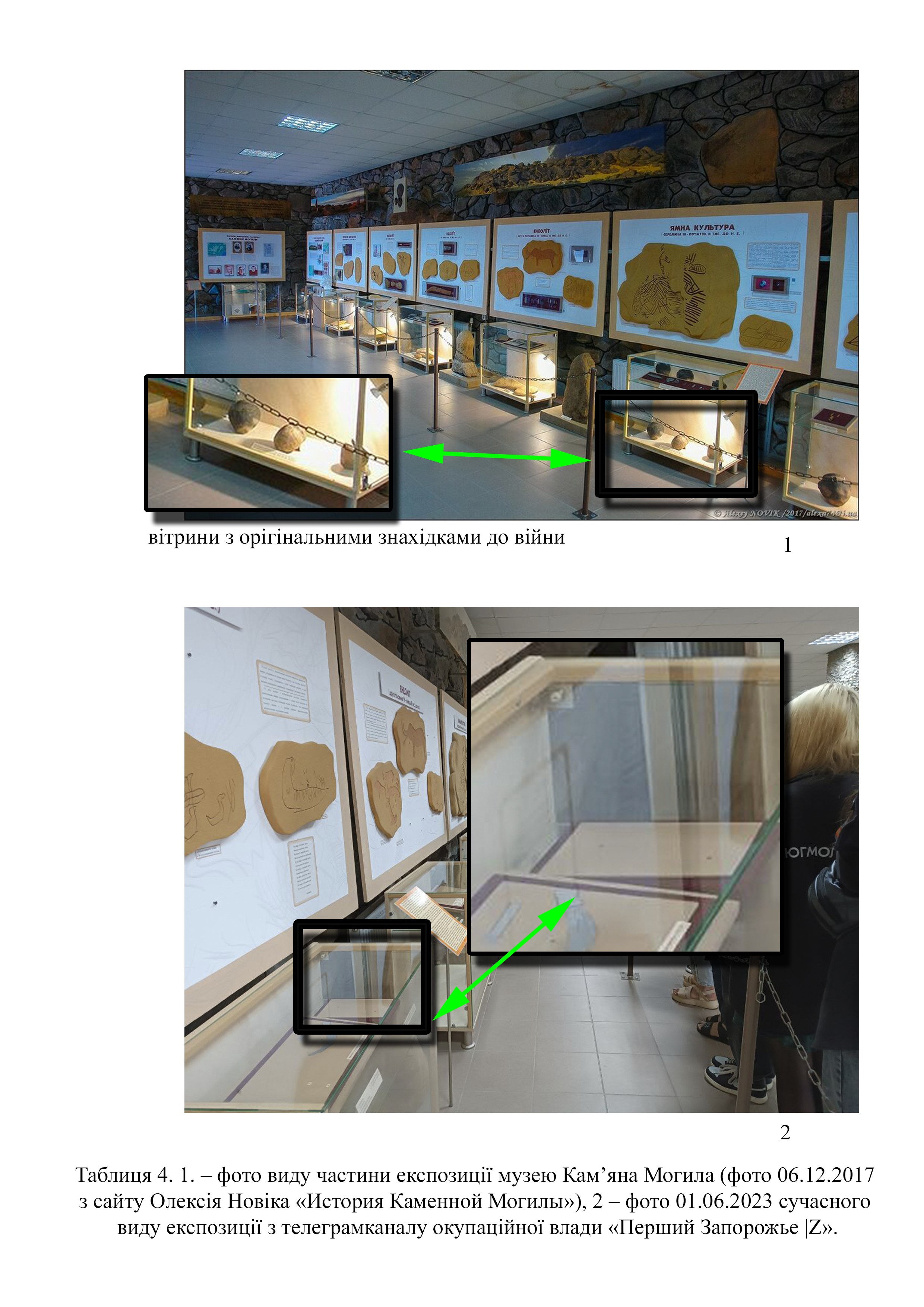
The basis for the modern exposition of the Stone Tomb Museum was laid by the founder and director of the reserve, B. D. Mikhaylov, in the 1970s. The fund collection includes numerous results of systematic excavations on and around the hill. This made it possible to continue the presentation of the typology of rock art samples (engravings on rocks, drawings on blocks, sculptures) and the chronology of the development of local cultures and art in the permanent exhibition (Table 4.1). After the museum obtained national status (Decree No. 1761 dated December 27, 2001 of the Cabinet of Ministers of Ukraine “On the entry of monuments of history, monumental art and archeology of national importance into the state register of immovable monuments of Ukraine”), items from various archaeological studies of other institutions started gradually entering its funds. Thus, by 2022, the collection included a wide range of exhibits: from anthropomorphic stelae, ornamented pots, to contemporary paintings.
Since 2006, the Kamiana Mohyla archaeological complex has been on the Tentative List of UNESCO's World Heritage and claims the right to inscribe the object on the main UNESCO World Heritage List.
The finds on Kamiana Mohyla hill are characterized by the prevalence of various items made from local sandstone. A separate vivid group of finds falls under the term “specimens of mobile art, which include the so-called churingas. According to the archaeological guide, it is a stone or wooden item in the shape of an oval or a fish, covered with geometric compositions or images of people, animals, birds (Dictionary-Handbook on Archeology, 1996, p. 304). Its name comes from the name of the object arunta (tjurunga or churinga in English), which is used by Australian natives during magical rites as a sophisticated musical instrument. The word “churinga” combines the meaning of something hidden (“thu”) and something of personal significance to the owner (“runga”) (Strehlow, 1947, pp. 85-86).
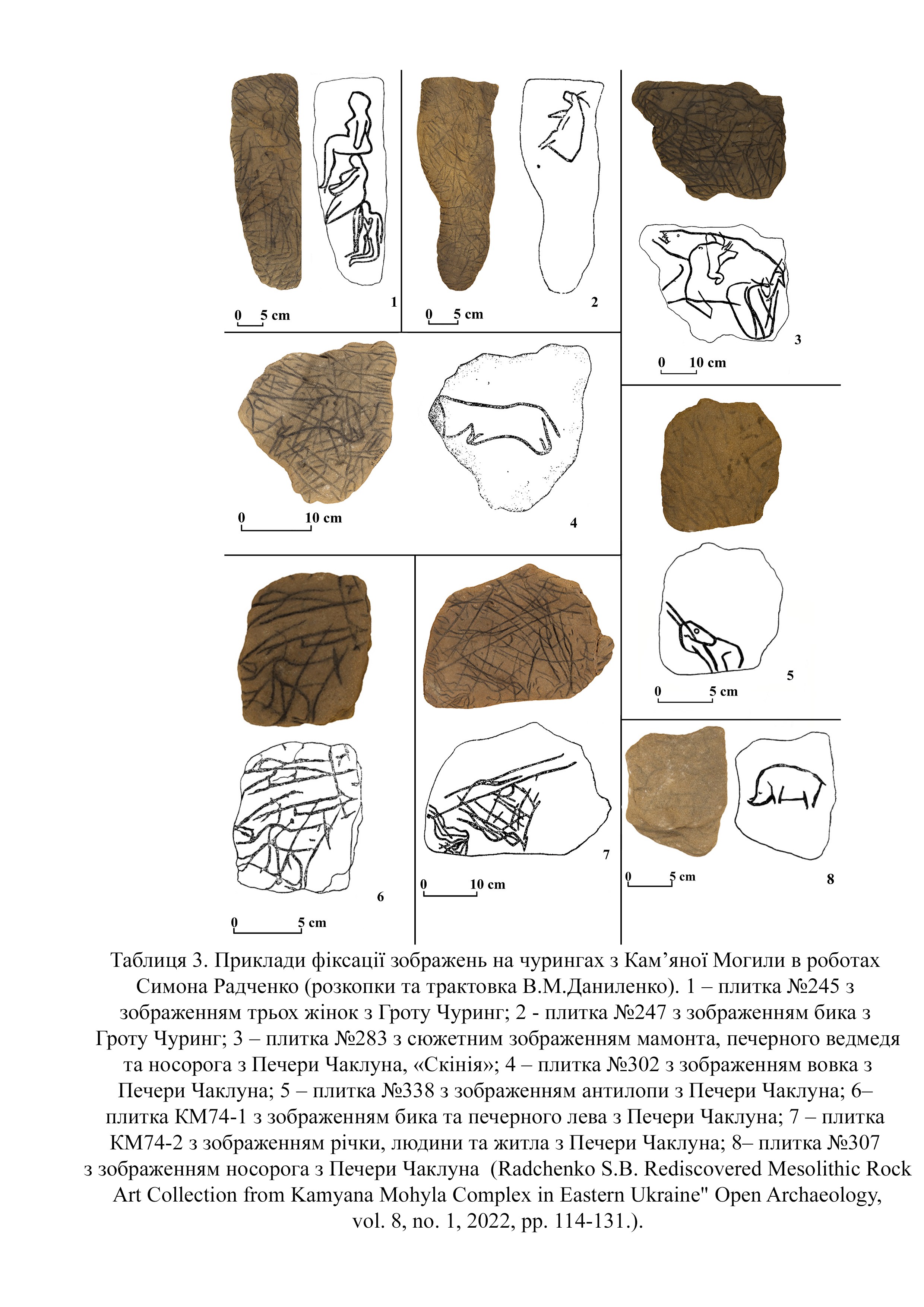
According to V. Danylenko's publications, in the 1973 season alone, during the excavations on Kamiana Mohyla hill in the Sorcerer’s grottoes, about 80 such carefully processed “churinga tiles” were found, similar to each other (Danylenko, 1986, pp. 94–129). The author emphasizes the complex, finely drawn ornament on the sides of the items (Table 3). Among some of them, he sees images of a “man with horns” and a Pleistocene animal (mammoth, rhinoceros) (Danilenko, 1986, pp. 95–98). The latter fact indicates the archaic nature of some of the tiles. In the monograph by B. D. Mikhailov, there are more of these items (Mikhailov finds about 230 more such objects). He agrees with the approximate date, but criticizes the term “churinga” as inept. In his opinion, the images on individual blocks of Kamiana Mohyla are only related to the representation of animal and human spirits.
In 2019–2023, a contemporary Ukrainian researcher Simon Radchenko (PhD) worked with churingas. In his opinion, the international term “portable art” organizes the researcher's work in a different typological way, so it is more suitable for characterizing such finds. We are grateful to Mr. Radchenko for his consent to use his personal photo archive and to describe the Kamiana Mohyla collection. According to his data, there are about 378 such items with geometric ornaments in the collections of various scientific institutions (228 of them are in the collections of the Kamiana Mohyla National Historical and Archaeological Preserve, one is in the collections of the Melitopol Museum of Local Lore, two are in the collections of the Zaporizhzhia Museum of Local Lore and the rest is in the departments of the Institute of Archeology of the National Academy of Sciences of Ukraine in Kyiv). The current research does not generally confirm Danylenko and Mikhaylov's conclusions about the Paleolithic age of the Kamiana Mohyla churingas, but emphasizes their uniqueness and special place in the study of ancient art. More specific dating of most of these objects is possible only after further archaeological and technological research.
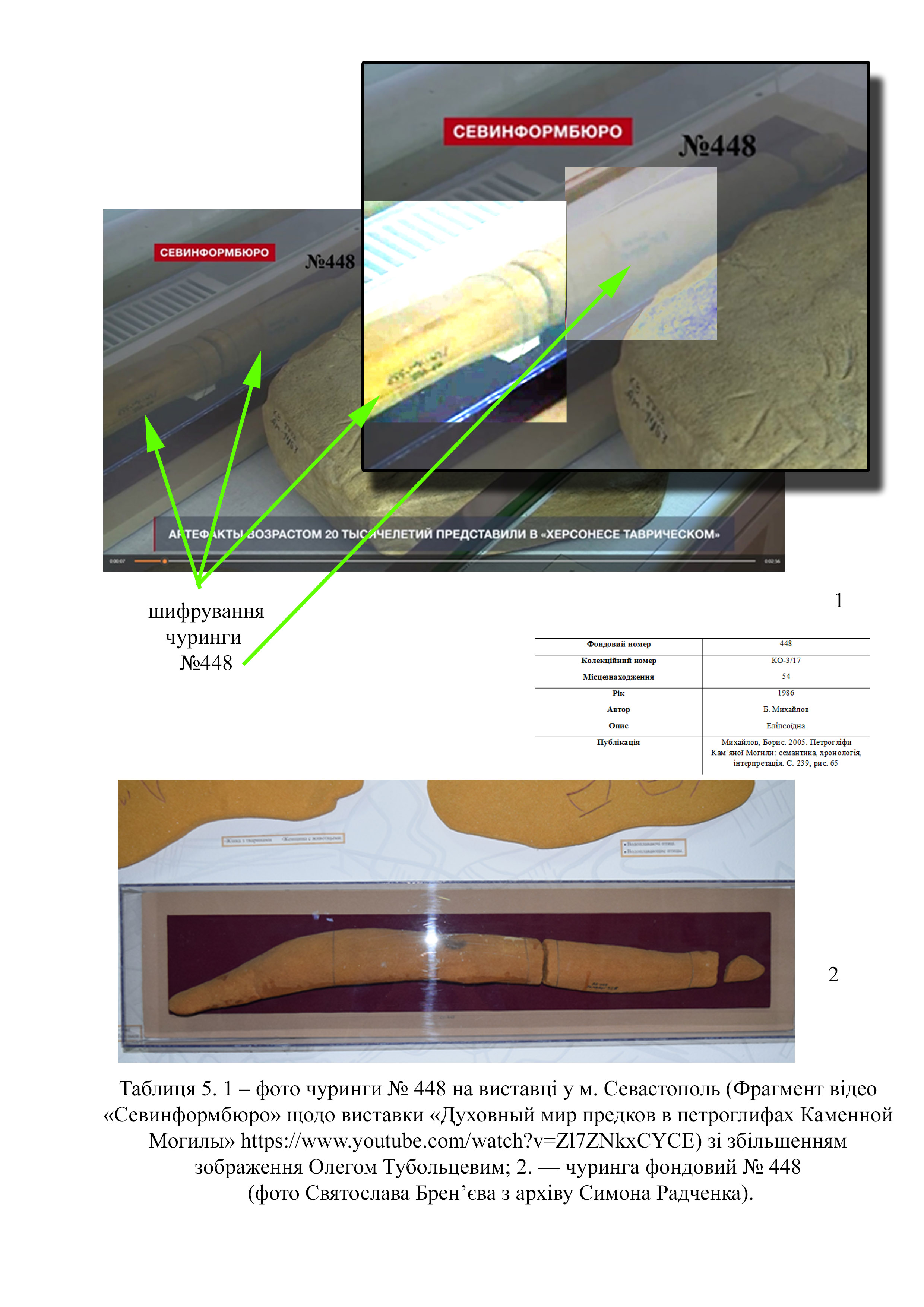
Churinga No. 448 was found by B. Mikhailov in the Churinga Cave in 1986. According to Rudynskyi-Mikhaylov, it is the d4 square of the map, the location is No. 54 (the so-called Churinga Cave) (Table 2). The collection number of the tile is KO-3/17. According to B. Mikhaylov's description, the item is ellipsoidal – a churinga: “It is a two-headed serpentine sculpture with numerous linear-geometric engravings on both sides of its body. One head has an eye and a raised nose, and the other has a flat nose with an eye.” The front and back sides are smoothed (Table 5). General dimensions are as follows: length – 70.4 cm; width – 4.5 cm; thickness – 4.7 cm.
Before the war, the site was in good condition. There are no damages, buildings, structures, small architectural forms, architectural elements, sculptures, etc. on the Kamiana Mohyla Hill monument. The vegetation is represented only at its foot by some shrubs.
According to the map of the war chronology, during the offensive in the south, on March 13, 2022, the Melitopol district was occupied by units of the National Guard of Russia (Chronology of the War, Current Time Agency https://www.currenttime.tv; Deep State Map https://deepstatemap.live).
According to the Deep State map, during the war, various military units were deployed near Kamiana Mohyla in Melitopol (129th motorized rifle regiment of the so-called Donetsk People's Republic, 34th separate motorized rifle brigade).
On October 14, 2022, a video was published where masked military personnel with weapons enter the territory of the Kamiana Mohyla National Preserve. The authors of this text believe that these were local police officers posing against the background of the hill with the permission of the museum administration (https://ria-m.tv/news/301055/v_melitopole_predateli_politsai_voorujivshis_do_zubov_v_bronejiletah_vyishli_na_ekskursiyu_(video).html)
During the formation of the occupying authorities, on May 9, 2022, Yevhen Balytskyi (former member of the regional parliament from the Party of Regions) became acting “governor” of Melitopol district (https://uk.wikipedia.org/).
On March 14, 2023, the State Duma of the Russian Federation adopted the federal law "On the peculiarities of the legal regulation of relations in the field of culture in connection with the admission to the Russian Federation of the Donetsk People's Republic, the Luhansk People's Republic, the Zaporozhye Region and the Kherson Region and the formation of new entities in the Russian Federation – Donetsk People's Republic Republics, Luhansk People's Republic, Zaporozhye Region and Kherson Region" (from March 18, 2023, No. 63-FZ). According to this law, all objects of cultural heritage that were in the registers of Donetsk, Luhansk, Zaporizhzhia and Kherson regions at the time of the State Duma's decision on the inclusion of the “DPR,” “LPR,” Zaporizhzhia and Kherson regions into the federation, as well as newly discovered objects on their territory, are automatically recognized as cultural heritage of the Russian Federation without state expertise. The decision to exclude these objects from the state register of cultural heritage sites will also be made without state expertise. The law has been submitted for adoption by the federal executive body authorized by the Russian government in the field of preservation, use, popularization and state protection of cultural heritage sites, and has been agreed upon with the highest executive bodies of the “DPR” and “LPR” and the occupation authorities of Zaporizhzhia and Kherson regions. (Evelina Kravchenko https://culture.voicecrimea.com.ua)
This led to a precedent in the form of the unification of the Chersonese Historical and Archaeological Museum-Preserve and the Kamiana Mohyla National Historical and Archaeological Preserve. According to Russian sources, this was initiated by Putin at a meeting with historians and representatives of “traditional religions of Russia.” This process is managed by Sergey Naryshkin, Director of the Foreign Intelligence Service of Russia (https://ria-m.tv/news/309514/rashistyi_prisvoili_arheologicheskiy_kompleks_kamennaya_mogila.html). The first reports about it in the Telegram social network and websites are dated October 5, 2022 (https://ria-m.tv/news/303013/putin_lichno_reshil_zabrat_muzey_kamennaya_mogila_pod_melitopolem_v_sobstvennost_rossii.html).
On the website of the President of the Russian Federation, among the list of orders, there is the order Pr-2372, which is addressed to the State Duma and orders to consider the issue of creating a branch of the Kamiana Mohyla museum on the basis of the Chersonese Historical and Archaeological Museum-Preserve. The person in charge of the task is M. Mishustin, Head of the Government of Russia. The deadline for implementation is May 15, 2023 (http://www.kremlin.ru/acts/assignments/orders/70073).
A lengthy text dated January 24, 2023 on the website of the Tauric Chersonese State Historical and Archaeological Museum-Preserve refers to this order on the establishment of the branch (Pr-2372 dated December 11, 2022). The date of the assignment and the persons responsible for preparation are indicated on the website of the Tauric Chersonese State Historical and Archaeological Museum-Preserve. Among them are director Ye. Morozova and “Minister of Culture of Zaporozhye Region” Yu. Kovanov.
As per Russian sources, Yuriy Kovanov, a representative of the occupied administration and the “Minister of Culture” of Zaporizhzhia Region, visited Crimea before it in January 2023. Together with Ye. Morozova, Director of the Chersonese Historical and Archaeological Museum-Preserve, and Igor Mikheyev, the so-called Deputy Governor of the city of Sevastopol, he recorded a video on local television on January 25, 2023 (NTS Channel – Independent Television of Sevastopol, “Kamennaya Mogila preserve near Melitopol to become part of Tauric Chersonesos Museum,”https://t.me/mikheevia/1052).
During February, the exhibits of the main and auxiliary fund of the Kamiana Mohyla National Museum were displaced. On the local website and the VKontakte social network, there is an interview dated February 20, 2023, where Sergey Danchenko, a “specialist” of the “Ministry of Culture, Sports and Tourism of Zaporozhye Region,” says that the main fund – more than 500 items – and the research and auxiliary fund – more than 600 items – were prepared for transfer to the city of Sevastopol (https://melitopol-news.ru/other/2023/02/20/25796.html). He expressed confidence that the professional qualities of the employees in Crimea would help “… to revive Kamiana Mohyla…”
According to online publications, in the city of Sevastopol on May 20, 2023, 120 exhibits were exhibited under the title "Spiritual world of ancestors in the petroglyphs of the Stone Tomb" (https://www.unn.com.ua/ru/news/2028923-u-sevastopoli-vistavili-eksponati-vkradeni-z-muzeyu-kamyana-mogila-pid-melitopolem). In the video and individual photos, only part of the exhibits are clearly visible (Polovtsian (Cuman) stele, pot with an ornament, sandstone samples with algae prints, a mammoth tooth). However, we still do not have all the information about these objects.
New photos and videos from the Internet show a display case with objects of mobile art from the main collection of the Kamiana Mohyla National Museum. Thanks to Simon Radchenko, we have established that one of the exhibits is churinga No. 4699 (Table 5).
According to the latest video statement on Sevinformburo channel (NTS Sevastopol) from June 5, 2023, “… in connection with the threat…” the curator of the exhibition of the Tauric Chersonese National Preserve, Pavel Khlebovskiy, was planning to leave the finds in the city of Sevastopol (https://www.youtube.com/watch?v=2uzppJS3s0w&ab_channel=%D0%9D%D0%B5%D0%B7%D0%B0%D0%B2%D0%B8%D1%81%D0%B8%D0%BC%D0%BE%D0%B5%D1%82%D0%B5%D0%BB%D0%B5%D0%B2%D0%B8%D0%B4%D0%B5%D0%BD%D0%B8%D0%B5%D0%A1%D0%B5%D0%B2%D0%B0%D1%81%D1%82%D0%BE%D0%BF%D0%BE%D0%BB%D1%8F%5C%D0%A0%D0%B5%D0%B7%D0%B5%D1%80%D0%B2).
Currently, exhibitions in the exposition of the Kamiana Mohyla museum are held near copies of the items (Table 4,2)
On March 12, an occupation administration was established with its center in the city of Melitopol, which is responsible for the entire territory. The occupation administration of Melitopol authorized the organization of the illegal and unauthorized transfer of Kamiana Mohyla to the Sevastopol-based Chersonese Historical and Archaeological Museum-Preserve.
According to the obtained data, the “unification” of the Kamiana Mohyla National Historical and Archaeological Preserve with the Tauric Chersonese Archaeological Museum-Preserve was initiated by President Vladimir Putin of Russia. He signed the decree Pr-2372 of December 11, 2022, where the head of the government – V. Mishustin – is designated a responsible representative of the state.
On the ground, this law was enforced by collaborators (“Governor of Melitopol” Yevgeniy Balitskiy; “Minister of Culture of Zaporozhye region” Yuriy Kovanov and “specialist” of the “Ministry of Culture, Sports and Tourism of Zaporozhye region” Sergey Danchenko) and occupiers, namely Yelena Morozova, Director of the Chersonese Historical and Archaeological Museum-Preserve, and Igor Mikheyev, the so-called Deputy Governor of Sevastopol.
Gallery
Additional files
information is clarified
Involved persons
information is clarified
Video gallery
information is clarified
Sources
- Bader O.M. (1949). Petrohlify Kamianoi Mohyly. Paleolit i neolit Ukrayiny. Kyiv: Academy of Sciences of the UkrSSR Publishing House, 1949. Volume I, Issue VI, pp. 297–322.
- Hladilin V.M. (1964). Do pytannia pro vik neskelnykh rysunkiv Kamianoyi Mohyly, Arkheolohiia, Volume XVI, pp. 82–88.
- Danylenko V.M. (1986). Kamiana Mohyla: monohrafiia. Kyiv: Naukova Dumka, 151 p.
- Radchenko S.B. (2022). Rediscovered Mesolithic Rock Art Collection from Kamyana Mohyla Complex in Eastern Ukraine. Open Archaeology, vol. 8, no. 1, pp. 114–131. https://doi.org/10.1515/opar-2022-0230
- Radchenko, S. (2023). Portable and Parietal art of Kamyana Mohyla, Ukraine. London: BAR Publishing.
- Rudynskyi M.Ya. (1961). Kamiana Mohyla (korpus neskelnykh maliunkiv): monohrafiia. Kyiv: Academy of Sciences of the UkrSSR Publishing House, 140 p.
- Mikhaylov B.D. (1994). Petroglify Kamennoy Mogily na Ukraine. Zaporozhye, 197 p.
- Slovnyk-dovidnyk Arkheolohii. Edited by V.V. Havryliuk et al. Kyiv: Naukova dumka, 1996. 430 p. ISBN 5-12-004847-1
- Strehlow, T.G.H. 1947. Aranda traditions. Melbourne.
Links
- Wikipedia. Yevgen Balitskiy
- Evelina Kravchenko. May 4, 2023 The Fate of Ukraine's Cultural Heritage Stolen by the Occupier, or Why the State Duma of the Russian Federation Passed the Law “On Peculiarities of Legal Regulation of Relations in the Field of Culture”
- RIA-Melitopol
- Current time. War Chronology: As It Happened
- NTS Channel – Independent Television of Sevastopol, “Kamennaya Mogila preserve near Melitopol to become part of Tauric Chersonese Museum.
- Ukrainska Pravda newspaper, Mariia Kabatsii ‘Russian occupiers open an exhibition of stolen goods from Kamiana Mohyla in Zaporizhzhia’
- Deep State Map
- Website of the President of the Russian Federation
- Google Earth Pro server
- The list of monuments of cultural heritage of national importance entered in the State Register of immovable monuments of Ukraine
- UNN, Yelizaveta Kalitventseva. Exhibits stolen from Kamennaya Mogila museum near Melitopol are exhibited in Sevastopol
- Churinga