General information
Location
Kind of cultural heritage
Object of architectureObject type
СonstructionsResearch zone
Donetsk regionMap
Object history and violation description
The Dormition Cathedral is the main church of the Holy Dormition Sviatohirsk Lavra (3 Zarichna Street, Sviatohirsk) and an architectural monument of national importance (Resolution of the Council of Ministers of the Ukrainian SSR of September 6, 1979, No. 442, protection No. 154/2). It was built between 1859 and 1868 (the foundation was laid in 1858 and consecrated in 1868). The construction of the new church was initiated by the hegumen of the Holy Dormition Sviatohirsk Monastery, Arsenii (Mytrofanov). The cathedral was designed by architect Oleksandr Hornostaiev (1808–1862) in the Russian-Byzantine or so-called pseudo-Russian style, characterized by a combination of Renaissance and Baroque and classical styles. The Dormition Cathedral was preceded by a stone cathedral of the same name, built in 1698–1708 and dismantled in 1867. The cathedral stands on a terrace, it is cross-domed, three-nave, four-pillared, with three altar apses, crowned with five cupolas with tent-shaped tops and domes. The total height of the cathedral to the cross is 53 meters.
With the establishment of Communist-Soviet rule in 1922, the monastery complex was converted into a recreation center with a capacity of 2,860 people, and the Dormition Cathedral became a cinema. The interior of the cathedral was completely changed: the iconostasis and the altar were dismantled, a stage was built, and a theater hall and back rooms were equipped. The exterior of the church was also changed. The completion of five cupolas of the cathedral and three altar apses (bulbs with crosses) were dismantled, and a superstructure was added to the central apse to accommodate stage equipment.
In 1933, the architect of the Kharkiv Institute of Urban Design, Serhii Hryhoriev, developed a project for the reconstruction of the building’s interior space with the arrangement of an auditorium and a foyer. Partitions were erected between the columns that divided the cathedral into three naves. Above the auditorium, the ceiling of the central nave was built on wooden structures (trusses). A stage was equipped in the central apse, and the side apses were adapted for costume rooms, dressing rooms and bathrooms.
During World War II, the Dormition Cathedral was damaged like other buildings, which necessitated its postwar restoration. According to the projects of the Kharkiv institutes Oblproekt and Dipromisto, developed in 1949–1952, the third reconstruction of the Dormition Cathedral took place.
Taking into account the cultural value of the Dormition Cathedral, which in 1979 was included in the list of architectural monuments by the Ukrainian government along with other buildings of the Dormition Sviatohirsk Monastery, repairs of the building’s facades began. In 1981–1985, the external restoration work with the reconstruction of the church cupolas and the installation of crosses covered with gold leaf was completed. However, for seven years after the restoration, the Dormition Cathedral looked like a cinema inside and continued to be used as the House of Culture of the Artem Sanatorium.
When the Holy Dormition Sviatohirsk Monastery resumed its functioning in 1992, the cathedral building was returned to the monastery. In June 1995, work began on the reconstruction of the sacral architecture of the Dormition Cathedral, and in 2000, its appearance again acquired the features of Russian-Byzantine architecture. The restoration of the interior decoration lasted until 2012. In 2019, the external restoration of the cathedral took place. The facade decoration and roof needed to be renewed, and its domes needed new gilding after 35 years of service. The structure of the cross on the central dome was also bent as a result of a storm, which raised concerns about the cross’s future stability in stormy winds. In October 2019, all restoration work was completed. Before the scaffolding was removed, the tents and roof of the cathedral were painted, the facades were repaired, and new gates with fancy forged door hinges were installed at the entrances of the northern, western and southern facades.
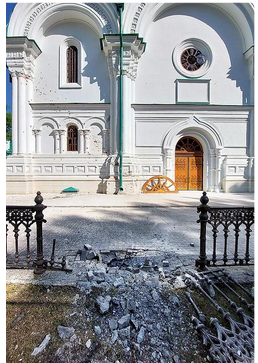
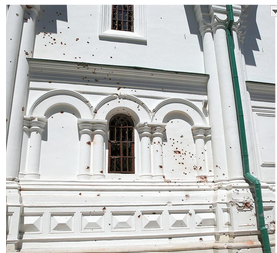
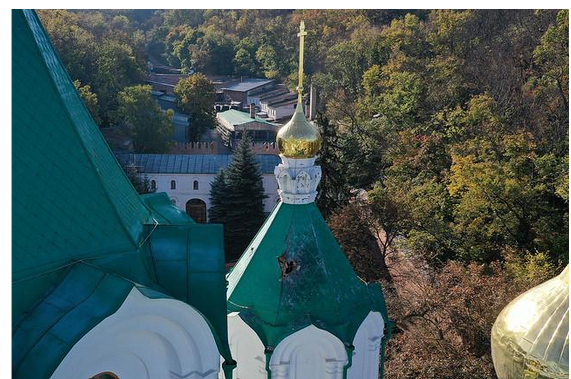
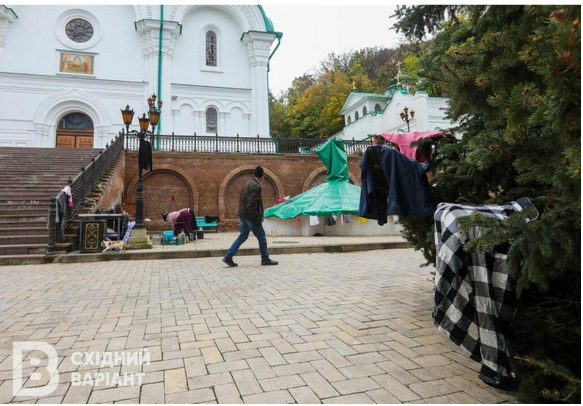
In the spring and summer of 2022, the Dormition Cathedral suffered from an air strike and artillery shelling. Numerous fragments damaged the southern façade of the church, and windows and doors were smashed. New damage was caused to the Dormition Cathedral on October 11, 2023, by a grenade launcher shot from the left bank of the Donets river. In particular, the southwestern dome of the cathedral was damaged in the place of the tent roof. Today, the condition of the building is satisfactory, but repairs to the basement, facades and window fillings are needed without the development of scientific and design documentation.
Gallery
Additional files
information is clarified
Involved persons
- - The Russian troops.
Video gallery
information is clarified
Sources
- Kostiuk O. (1987). Slovianohirsk. Pamiatnyky Ukrainy [Slovianohirsk. Monuments of Ukraine]. No. 2.
- Dedov V. N. (1995). Svyatyye Hory: Ot zabveniya k vozrozhdeniyu [Holy Mountains: From Oblivion to Revival]. Kyiv.
- Diadiushenko H. (1996). Holovnyi khram Sviatohirskoho monastyria [The main temple of the Sviatohirsk monastery]. From the history of Ukrainian restoration.
- Pamiatky arkhitektury i mistobuduvannia Ukrayiny: Dovidnyk Derzhavnoho reiestru natsionalnoho kulturnoho nadbannia [Monuments of Architecture and Urban Planning of Ukraine: Handbook of the State Register of National Cultural Heritage]. Kyiv, 2000.