General information
Location
Kind of cultural heritage
Museum objectsObject type
information is clarifiedResearch zone
Kherson regionObject history and violation description
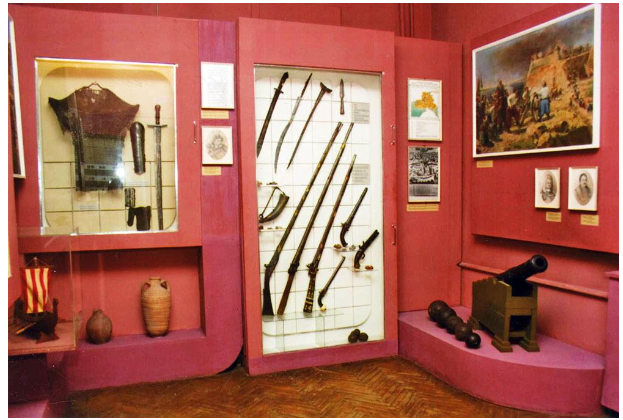
The museum is located in Kakhovka, Kherson region. Founded in 1940 as a museum of the history of the Kakhovka bridgehead.Initially, it had 146 storage units. In 1941, it was evacuated to Astrakhan (Russia), and in 1957, it was restored under its present name. Since then, it was headed by V. Lebedev, followed by O. Shulzhenko in 1974–1991 and S. Sydolkina from 1991 until the Russian invasion. Since 1965, it has been a branch of the Kherson Regional Museum of Local Lore. About 15–16 thousand exhibits were registered in the funds. The museum included the following sections: “Native Land in Ancient Times,” “Zaporozhian Era,” “Settlement and Economic Development of the Region in the 1st Half of the 19th Century,” “Ethnography and Life of the Ukrainian Village in the 2nd Half of the 19th Century,” “Kakhovka in the Early 20th Century.”
Among the exhibits are anthropomorphic stelae of the Yamna culture of the 3rd millennium BC, found near the villages of Liubymivka and Osokorivka, the top of a mace of the Catacomb culture (2nd millennium BC, Arkhanhelska Sloboda village), ancient Greek amphorae from the Late Scythian Liubymivka settlement (1st – 2nd centuries BC), a Scythian ritual hilt (5th century BC, Dogmarivka village), a golden Sarmatian earring (I century AD, Mala Kakhovka village), Polovtsian stone kurgan stelae (11th – 12th centuries, Kakhovka), early medieval chandeliers; cold weapons and Turkish firearms of the late 18th and 19th centuries: palashes, yatagans, sabers, pistols, rifles (including the work of the gunsmith A. Memet – a flintlock rifle decorated with ivory and turquoise), sabers of the period of hostilities of 1918–1920 and World War II, the saber of the last Emir of Bukhara Seyid-Alim Khan (Damascus steel, silver, gilding), firearms and cold weapons, ammunition, equipment and uniforms from private to marshal of World War II, Semyon Budyonny’s marshal uniform of 1935; a collection of coins from ancient times to the present, pre-revolutionary medals, orders of leading workers of the 1920s. Kakhovka region in the 1920s and 30s, Nazi Germany insignia and medals, awards of the Soviet Union's heroes Ya. Babenko and T. Pyrohov.
The written sources include nearly 8,000 items, covering the period from 1695 and revealing the history, social, political and cultural life of the region. There are a significant number of photographs of industrialists and entrepreneurs of the city, workers of Kakhovka enterprises, streets and buildings of the 19th and early 20th centuries, the Latvian, 15th, 51st, 52nd Rifle Divisions and the 1st Cavalry Army, which participated in the battles at the Kakhovka bridgehead.
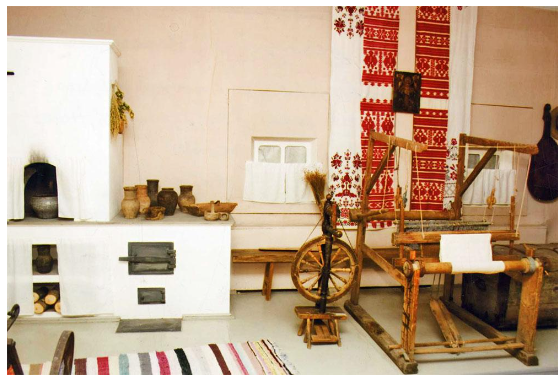
The cultural and household complex is represented by Ukrainian shirts, corsets, headdresses (caps, brilli, scarves), towels from the southern and central regions of Ukraine, household utensils (jugs, makitras (mixing bowl), nochvy (washtubs), kovhanky (mortar and pestle), cauldrons), spinning and weaving tools. The museum staff has collected memoirs of eyewitnesses of the 1932–33 Holodomor, soldiers of World War II and military operations in Afghanistan.
Separate expositions are dedicated to the founders and owners of Kakhovka in 1791–1879: the Ovsianyk-Kulikovskyis, the owners of Kakhovka in 1879–99, the Pankeyevys, landowners in the Dnipro district, and Faltz-Feins, and prominent natives of the city. A number of studies by the museum's staff have been published in the collections of scientific papers of Kherson, Odesa, Dnipro, Rivne, Zhytomyr and Lviv regional museums.
Among the exhibitions there are “Falz-Feins: Past and Thoughts” (1999; opened by Baron E. Falz-Fein of Liechtenstein), “To the 140th Anniversary of the Education of Kakhovka Region” (2001), “From an Afghan Photo Album” (2009), “Rarities of the Great Patriotic War” (to the 65th anniversary of the Victory), “On the Edge of Millennium” (1999), “Colors of the Native Land” (2007; both are paintings), “India. The Himalayas: in the places of the Roerich expedition” (1999), “Flowers and Mountains of Crimea” (2000; B. Shuliko), “Walking the Streets of Old Kakhovka” (2006), “Poetry of Life Impressions” (2010; all photographs), “Colors of Ukraine” (2002; photographs of Kharkiv, Poltava, Kherson, Kakhovka), “Traditions and Modernity” (2003), “Everything That We Hold Dear” (2007), “New Year's Extravaganza” (2008; decorative and applied art), “There Are No Other People's Children” (2008). Local lore conferences for students have been held here since 1990.
On November 24–25, 2022, it became known that the museum's collections were taken to the temporarily occupied Crimea.
Gallery
Additional files
information is clarified
Involved persons
- - The Russian military and scientists.
Video gallery
information is clarified
Sources
Links
- The Russians took all the funds of the Kakhovka Museum of History to the Crimea
- Russian invaders looted the Kakhovka Museum of History, - the Center of National Resistance Source: https://censor.net/ua/n3382734
- The Russians plundered the historical museum in Kakhovka and took everything to Crimea - CNS