General information
Location
Sviatohirsk town, Donetsk region, Kramatorsk district, 3 Zarichna Street
Kind of cultural heritage
ArchaeologicalObject type
СonstructionsViolation type
information is clarifiedResearch zone
Donetsk regionMap
Object history and violation description
A monument of architecture and urban planning of national importance, Resolution of the Council of Ministers of the Ukrainian SSR of August 24, 1963, No. 970, protection No. 154/1).
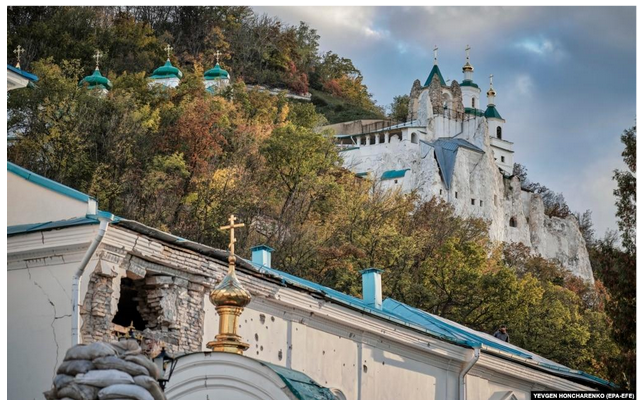
St. Nicholas Church is the oldest surviving building of the Holy Dormition Sviatohirsk Lavra. Originally, it was a cave cathedral church of the Dormition of Virgin Mary. The destruction of the upper part of the cliff in the late 17th century led to the reconstruction of the remains of the old cave church into St. Nicholas Church. According to updated information, the church was rebuilt between 1679 and 1690 at the expense of Colonel F. Shydlovskyi of the Izium Regiment. The new church was built in the Ukrainian Baroque style, its stone part is so organically embodied in the rock massif that without special research methods it is impossible to determine the places where bricks turn to chalk and identify chalk layers in the walls of the church. At the same time, the unity of the temple with the natural material of the chalk rock and the surrounding natural landscape make the religious building a unique object of cultural heritage of Ukraine, which has no analogues. In 1839, Archbishop Meletii (née M. Leontovych) of Kharkiv and Okhtyrka, a well-known religious figure, teacher and missionary, served here; in 1851, the church was consecrated by Bishop Filaret (née D. Humilevskyi), a well-known historian and theologian; and in 1895, the Nobel Prize-winning writer I. Bunin attended the service. It should be noted that St. Nicholas Church suffered considerably during World War II and was restored in the late 20th century. Today it is a three-section (consisting of nave, sanctuary and narthex (babynets)), three-story religious building, and the domes above the altar and the narthex are decorative.
The building was damaged as a result of bombing attacks and artillery shelling that took place between March 12 and August 2022. The condition of the building is currently satisfactory. It requires current repairs – plastering – without the development of scientific and design documentation.
Gallery
Additional files
information is clarified
Involved persons
- - Troops of the Russian Federation
Video gallery
information is clarified