General information
Location
Kind of cultural heritage
ArchaeologicalObject type
СonstructionsResearch zone
Luhansk regionMap
Object history and violation description
Popasna is a city in the Sievierodonetsk district of the Luhansk region of Ukraine, the administrative center of the Popasna city community. Until 2020, it was the administrative center of the Popasna district.
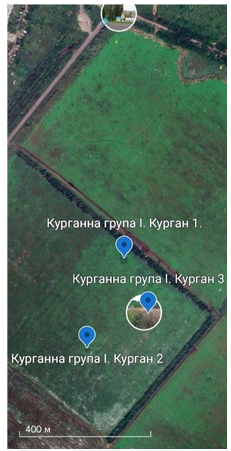
Barrow group I is located on a high watershed plateau 0.9 km southwest of the southwestern outskirts of Popasna or 0.76 km southwest of the intersection of the Pervomaisk-Bakhmut-Popasna-Troitske highway. It consists of three mounds.
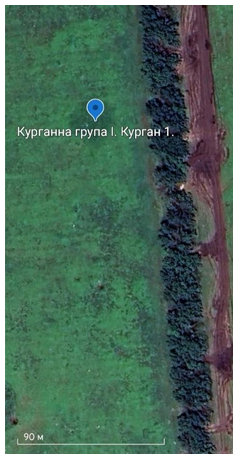
Barrow 1 is 1 meter high and 22 meters in diameter. In terms of size, this barrow is average among those found in the Luhansk region. Most of the barrows here do not exceed 3 meters in height and 30 meters in diameter and date back to the Bronze Age (late 4th – late 2nd millennium BC), mainly to its middle (17th – 21st centuries BC) and late (18th – 13th centuries) periods. The barrow is of local importance and is newly discovered. It is not included in the register of immovable archaeological sites.
On the territory of the Luhansk region, the barrow funeral rite began to be used in the Early Aeneolithic era and is associated with the population of the Skelianska culture (second quarter of the 5th – early 4th millennium BC). The Copper Age period (Aeneolithic) was the time when the first shepherds appeared on the historical scene in Ukraine and, with them, burial structures known in the oral tradition as graves and barrows. Since then, they have been an integral part of the steppe landscape. But they became numerous here during the Bronze Age, the heyday of the Ancient Eastern civilizations. In the Luhansk region during the Bronze Age, this funerary tradition is associated with the population of the Yamna (32nd–25th centuries BC), Catacomb (27th–21st centuries BC), Babynska (21st–18th centuries BC) and Zrubna (18th–13th centuries BC) cultural communities. Based on the spread of the barrow rite (and thus the carriers of “barrow” cultures of the Aeneolithic-Bronze Age), researchers study the migration of Indo-European tribes across Europe and Asia.
The most common burials in Luhansk barrows are those of the Catacomb and Zrubna cultures. There is reason to believe that the population growth in the Donetsk-Luhansk region was the consequence of the presence of copper ore deposits that attracted the ancient population. The location of this barrow in the immediate vicinity of the Kartamysh copper ore deposit (3 km northwest of it), which was actively mined by the ancient population in the Bronze Age, makes it extremely interesting.
There are much fewer Early Iron Age barrows in the region associated with the Cimmerians (9th–8th centuries BC), Scythians (7th–3rd centuries BC), Sarmatians (2nd century BC–4th century AD) and the Middle Ages, when the region was inhabited by the Bulgars, Pechenegs, Torks and Cumans (6th–13th centuries).
External features of the barrows, including their size, suggest the time of their construction. Among the funerary dowries of people buried during the Iron Age, there are precious metal items.
At the very beginning of the Russian-Ukrainian war in Donbas, in 2014, Popasna city changed hands several times. Back then, Popasna was under occupation for two and a half months. According to Roman Vlasenko, the head of the Popasna District State Administration (December 2014 – October 2016), the Ukrainian military practically did not use heavy weapons during the liberation of the city.
After the signing of the Minsk accords, Popasna found itself in the frontline area, and the city and its surroundings were sometimes shelled by Russian militants. Ukrainian forces created a strongly fortified area in and around Popasna.
In March 2022, the Russian army launched an offensive in the Rubizhne-Sievierodonetsk-Popasna area, which was met with fierce resistance by the Ukrainian Armed Forces. The battle for the city, which is of great strategic importance, lasted for more than two months. The city was bombarded with heavy artillery fire, and in the second half of April, street fighting broke out. As a result of the fierce battles, Popasna was completely destroyed. The area around Popasna with its archaeological sites was also heavily damaged.
Under such conditions, the protection zone of the barrow was violated. Explosion craters were recorded 5 meters from the southwestern hemline and 10 meters from the southern hemline of the barrow. The diameter of the craters reaches 6 meters.
On May 8, 2022, the Ukrainian military were forced to retreat in the direction of Bakhmut, and since then, Popasna has been controlled by Russia.
Gallery
Additional files
information is clarified
Involved persons
- - It is difficult to identify those involved in the destruction of the barrow, as Popasna changed hands repeatedly. However, given the scorched earth tactics of the Russian armed forces, evidenced by the density of shelling of both the city and its surroundings during the offensive, it is the Russian military that is most likely involved in the destruction of this barrow and the violation of its protection zone.
Video gallery
information is clarified
Sources
- Brovender Yu. M. (2021). Donetskyi hirnycho-metalurhiinyi tsentr i vyrobnychi tsentry skhidnoyevropeiskoho stepu doby bronzy: porivnialnyi analiz vyrobnychoi diialnosti [Donetsk mining and metallurgical center and production centers of the Eastern European steppe of the Bronze Age: a comparative analysis of production activities]. Archaeology and Ancient History of Ukraine, 2(39), pp. 109–118.
- Brovender Yu. M. (2022). Kartamyskyi hirnycho-metalurhiinyi kompleks doby bronzy [Kartamysh mining and metallurgical complex of the Bronze Age]. Ukrainian Archeology in Times of Independence. Kyiv: Institute of Archaeology of the National Academy of Sciences of Ukraine, pp. 131–136.
- Brovender Yu. M. (2023). Donetskiy gornorudnyy tsentr epokhi pozdney bronzy kak faktor demograficheskogo vzryva v Srednem Podontsovye [Donetsk mining center of the Late Bronze Age as a factor of the demographic explosion in the Middle Severskiy Donets river basin]. More lasting than bronze. Essays in honour of Valentin Dergachev on the occasion of his 80th birthday. Higher Anthropological School University; compiled and edited by L.V. Dergacheva; editorial board: D. A. Topal (et al). Chisinau: Stratum Plus (Blitz Poligraf), pp. 519–528.
Links
- Militants covered Popasna with "Hrads". One dead, four injured
- Cities that have disappeared. What remains of settlements in eastern Ukraine after the “liberation” by the Russian army
- Popasna under the control of Russian troops: what the city looks like now
- Popasna - A Town Which Doesn't Exist
- Drone footage shows how Russians destroyed one Ukrainian town in savage battle