General information
Location
District - Chornomorks district
City - Located between the northern outskirts of present-day Chornomorske urban-type settlement and Novosilske village, on the rocky cape of the southeastern coast of Ak-Mechet Bay.
Autonomous Republic of Crimea
Kind of cultural heritage
ArchaeologicalObject type
ComplexesResearch zone
Autonomous Republic of CrimeaMap
Object history and violation description
The Greco-Scythian hillfort is located between the northern outskirts of present-day Chornomorske urban-type settlement and Novosilske village, on the rocky cape of the southeastern coast of Ak-Mechet Bay.
The settlement of Chersonesos was founded in the 4th century BC as a starting point for the development of the lands of the northwestern part of the peninsula. The territory of the city (3–4 hectares) was surrounded by a solid fortress wall with square towers made of large limestone blocks. The settlement was built according to the tenets of ancient architecture by analogy with the Chersonesian planning system, resembling the Chersonesian houses of Kalos-Limen.
The agricultural territory of the city (chora) was situated around Ak-Mechet Bay with the radius of 2 km. Road networks intersect at right angles, dividing the outskirts of the bay into regular rectangular sections (kleroi), numbering from 40–60 to 120–160; the area of each of them is approximately 9 hectares. In addition to agriculture, inhabitants of the city were engaged in fishing (fish bones and fishing hooks are often found during excavations) and various crafts.
Findings of tombstones among the construction remains of Kalos-Limen indicate the existence of a necropolis, but it has yet to be discovered.
Scythians raids forced the Greeks to strengthen the existing fortifications and build a new line of defense – a multi-towered citadel near the bay itself. There is information about a 16-meter lighthouse, in whose basements food supplies were stored in case of a siege. On the upper floors, there was a command post and stone-throwing tools were installed to control the entrance to the bay. However, all these measures only postponed the fall of Kalos-Limen, which was captured by the Scythians in the 2nd century BC. During the Diophantus Wars (114–111 BC), the Greeks briefly regained control of the city. The Scythians replanned it: a moat with stone lining was dug in the defense system, and the inner territory was built up with stone houses with courtyards. In the central part of the settlement, a megaron-type room was built (the type of the oldest Greek dwelling which formed back in the days of the Aegean culture and is common on the islands of the Aegean Sea, on Crete, in mainland Greece and Asia Minor. The megaron is a rectangular building with a portico. Inside the halls, a hearth was arranged). Numerous semi-dugout shelters, round in plan and partially depressed, were also discovered.
To the southwest of the settlement is the mound necropolis of Kalos-Limen with Greek burials from the 4th to the early 3rd century BC built of raw bricks and some Scythian graves of the 2nd–1st centuries BC. At the end of the 1st – early 2nd century AD, Kalos-Limen ceased to exist.
It was registered by the Decision of the Crimean Regional Executive Committee dated January 15, 1980 No. 16 (reference No. 1785).
The resolution of the Council of Ministers of the Crimean ASSR (No. 298) dated December 19, 1991 established the boundaries of the protected zones of the monument, which saved the hillfort and its necropolis from modern construction and human economic activity.
In 1997, the Ministry of Culture of Ukraine created the Kalos-Limen Republican Historical and Archaeological Preserve for the study and promotion of this unique archaeological site on the territory of the ancient city. In Chornomorske urban-type settlement itself, there is the Kalos-Limen Museum.
After the occupation of Crimea in 2014, the property of the preserve and museum were taken over by the so-called State Budgetary Institution of the Republic of Crimea “Kalos Limen Historical and Archaeological Museum-Preserve.”
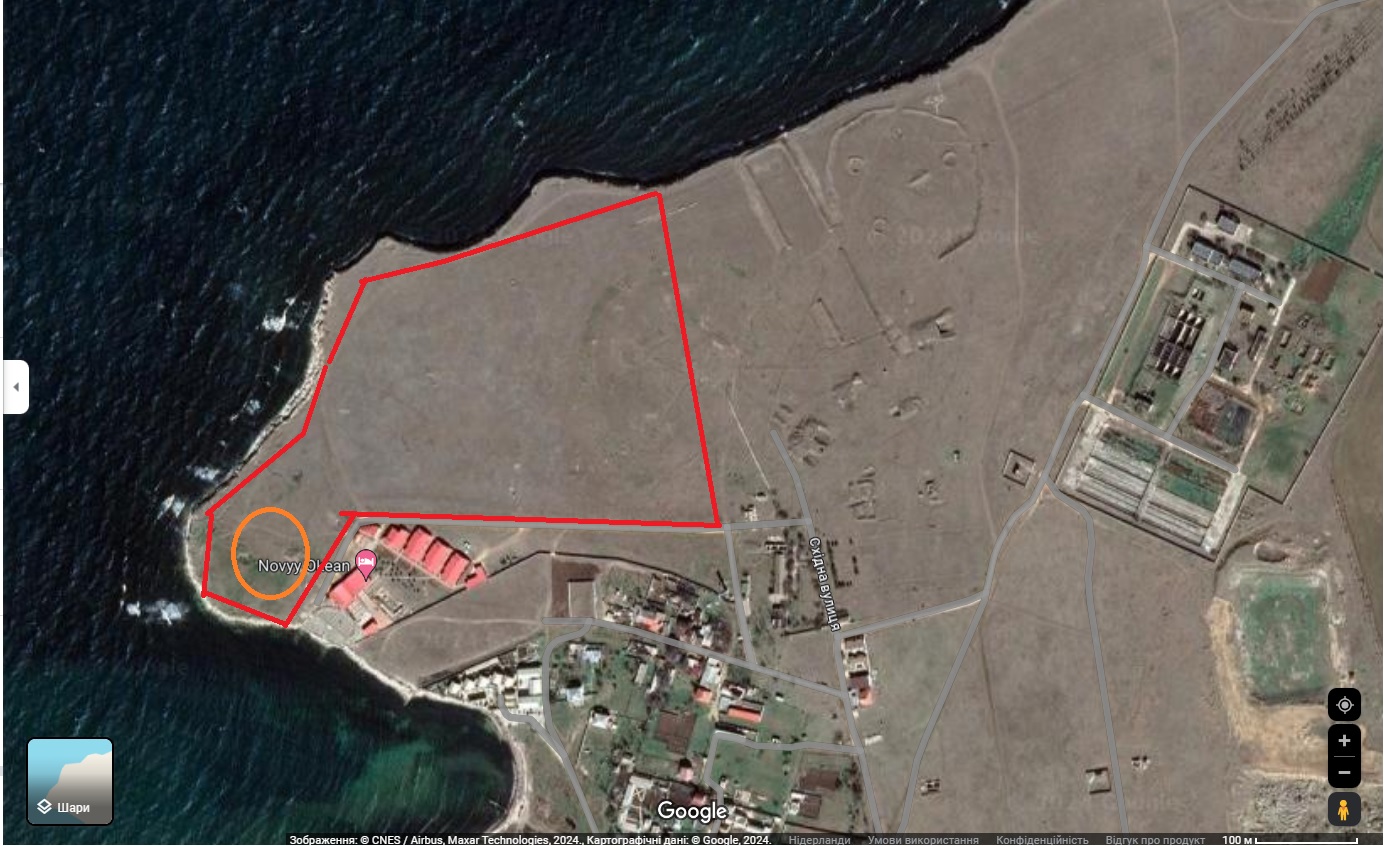
In the course of illegal archaeological works carried out in 2021, a visual inspection of the surface was conducted within the territory of the proposed construction project “Complex of apartments at the address: Crimea, Chornomorske district, Territory of the Novosilske village council (stages I–V),” and 11 exploration pits were made. Illegal excavations were carried out in 2021 by the expedition of AMI LLC under the leadership of the owner of the open letter (permit) S. A. Muld. As a result, an object of cultural heritage was discovered – “ Fragment of the chora of Kalos-Limen (Fragments of boundary and plantage walls of the chora of Kalos-Limen).” This object includes 11 preserved agricultural terraces.
Based on the conclusions of the so-called Act of the state historical and cultural examination of the section of documentation justifying measures to ensure the preservation of the cultural heritage object “Fragment of the chora of Kalos-Limen (Fragments of boundary and plantage walls of the chora of Kalos-Limen),” compiled by Roman Smolyaninov (head of the Lipetsk-based regional scientific civic organization “Archaeological Research”), and the fact that the object was not put on a register by the occupying authorities, the monument is going to be excavated “for demolition.”
Gallery
Additional files
Involved persons
- - Ministry of Culture of the Russian Federation
- - Archaeological Research Lipetsk Regional Scientific Civic Organization (in Russian – LRNOO “Arkheologicheskiye issledovaniya”)
- - Roman Smolyaninov
Video gallery
information is clarified
Sources
Links
information is clarified